Projects

Practice Tracker

A local-first habit tracker that works without an account

Status
MVP
Type
Product System
Updated

A usable lightweight habit tool with custom habits, daily check-ins, streaks, seven-day statistics, and JSON backups.

Verifiable entry points

Demo and source

Public demo

Create a habit and check in without signing in; data stays in the current browser.

Open Tracker

Source evidence

Review schema parsing, serialization, validation, streaks, and seven-day statistics.

Evidence

Public route

The Tracker page is covered by bilingual public routes, sitemap, and browser verification

Usable loop

Create habits, check in or undo, inspect streaks and seven-day stats, then delete or reset with confirmation

Data boundary

Records persist only in the current browser and move through a versioned JSON backup

Asset status

Only repository-backed product mocks, public documentation, or an explicit no-public-image explanation appear here.

Asset type: Product mock
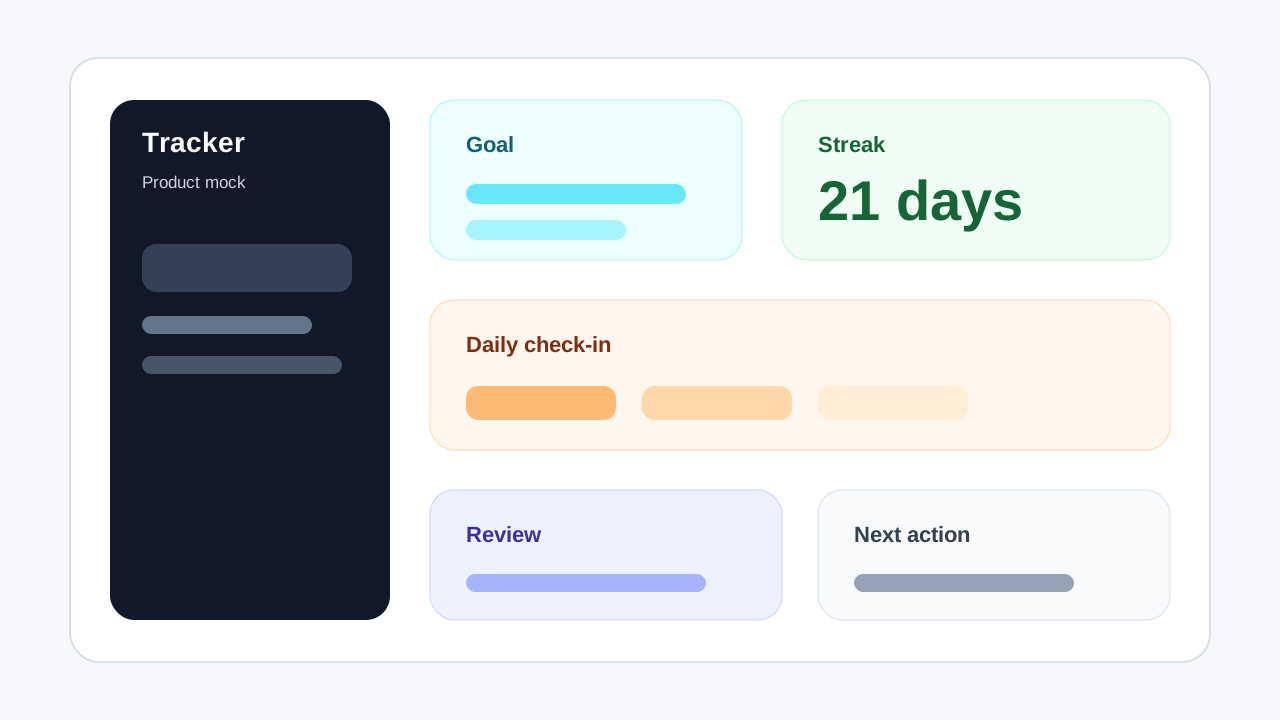
Product mock
Product mock for the Practice Tracker showing goals, check-ins, streaks, and review modules
Product mock: it explains the Tracker structure. The live page persists to localStorage without accounts or cloud sync.

Asset type: Documentation

Read the local-first feature notes

The public notes document the v1 schema, capacity limits, import validation, backups, and privacy boundary.

Read the local-first feature notes

Problem

Many trackers only record whether a task was completed, without enough structure for goals, streaks, incentives, and anti-abuse boundaries.

Solution

Use daily check-ins as the core loop, persist records in the browser, and provide strictly validated import and export so progress remains observable and portable.

My role

  • Product rule design
  • Frontend implementation
  • Interaction flow
  • Incentive model

Stack

  • Next.js
  • TypeScript
  • Tailwind CSS

Highlights

  • Works without sign-in
  • Portable local backups
  • Strict input and backup validation

Architecture

The interactive client stores a versioned v1 schema in localStorage. Imports are bounded and validate fields, dates, duplicates, and counts; the server never stores habit records.

  1. Step 01

    Client interface

    Habit creation, check-in, undo, delete, and reset all run in the browser.

  2. Step 02

    v1 schema validation

    One boundary validates names, dates, duplicates, record counts, and imported file size.

  3. Step 03

    localStorage

    Versioned plain-text data stays in the current browser and is not uploaded to the site server.

  4. Step 04

    Local stats and backup

    Local records produce streak and seven-day stats and move through manual JSON import and export.

Key decisions and impact

  1. Decision 01

    Use an account-free local-first data model

    Rationale
    Basic personal check-ins do not need habit records to enter a server or account system.
    Impact
    Deployment and privacy exposure stay small, but data does not sync across devices automatically.
  2. Decision 02

    Put backup files through strict validation

    Rationale
    Imported JSON replaces local state, so version, fields, dates, duplicates, and capacity must be bounded first.
    Impact
    Migration is predictable; invalid files are rejected without overwriting current data.
  3. Decision 03

    Focus statistics on streaks and the latest seven days

    Rationale
    The first release favors feedback that is easy to explain and recalculate from local records.
    Impact
    The core loop stays clear while monthly and longer-term review remains on the roadmap.

Trade-offs

  • Skipping accounts and a database keeps use and deployment light, but removes automatic cross-device sync.
  • localStorage provides real persistence at zero server cost, but users must export before clearing browser data.
  • Statistics stay focused on seven-day completion and active streaks so the rules remain explainable and portable.

Roadmap

  • Add a monthly review
  • Offer CSV export
  • Evaluate the cost and privacy boundary of optional encrypted sync

Current limitations

  • Data stays in the current browser
  • No account, reminders, or cloud sync
  • Users must protect their own backup files

Next steps

  • Add a monthly review
  • Support more portable formats
  • Keep refining local-first privacy copy

Keep exploring

Related entry