Projects

Dashboard Console

An internal operations console for tasks, logs, events, and system status

Status
MVP
Type
Dashboard
Updated

An operations console for the personal website that brings tasks, logs, events, and system state into one maintainable view.

Verifiable entry points

Demo and source

No public demo

The console contains internal tasks, events, logs, and deployment state and requires administrator authentication, so it has no public demo.

Source evidence

Start with the API implementation, then inspect the companion dashboard-web client and tests in the same repository.

Evidence

State aggregation

Tasks, logs, events, and system status are shaped into one console model

Conflict boundary

OSS and ETag conflicts remain explicit design constraints

Expansion path

The console can host content operations, deployment records, and Knock summaries

Asset status

Only repository-backed product mocks, public documentation, or an explicit no-public-image explanation appear here.

Asset type: Architecture diagram
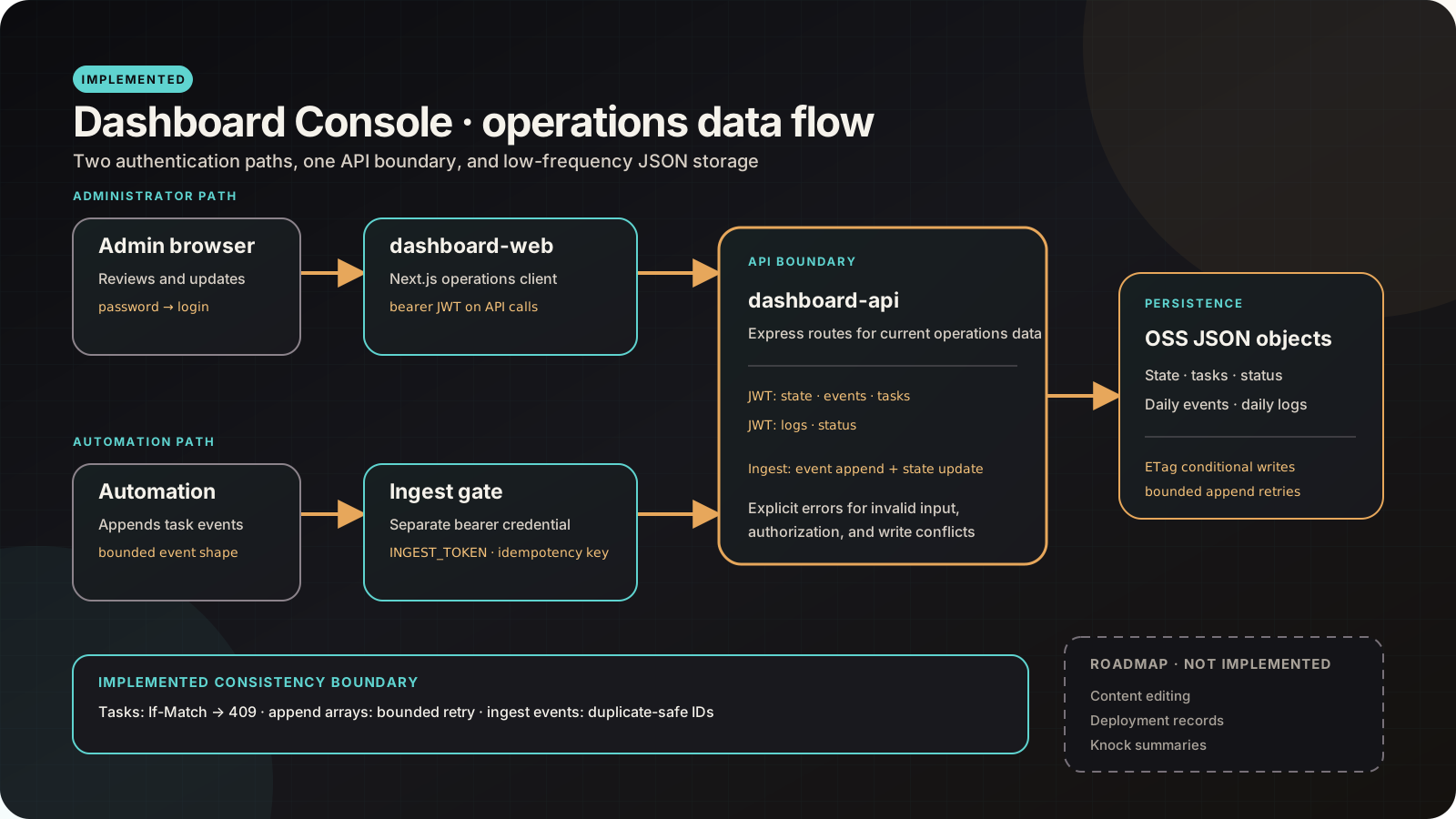
Architecture diagramOpen full-size diagram
Current Dashboard Console architecture: separate administrator JWT and automated ingest paths reach dashboard-api, which reads and writes OSS JSON objects with ETag boundaries
Architecture diagram: the implemented dual-authentication paths, API, OSS JSON storage, and consistency boundaries are shown without real buckets, domains, credentials, or operations data. Content editing, deployment records, and Knock summaries are explicitly marked as roadmap work.

Asset type: Documentation

Read the Dashboard architecture plan

The public plan records the monorepo shape, OSS data layout, API surface, ETag rules, and test requirements.

Read the Dashboard architecture plan

Problem

Content, deployments, logs, and tasks are scattered across tools, making it hard to understand current system state and the next priority.

Solution

Use dashboard-api to read and write tasks and events, while dashboard-web presents actionable state views with OSS and ETag conflict boundaries.

My role

  • API design
  • OSS storage integration
  • Conflict handling
  • Console information architecture

Stack

  • Node.js
  • TypeScript
  • React
  • OSS

Highlights

  • Clear read/write error boundaries
  • Trackable task state
  • Expandable into content operations

Architecture

dashboard-api owns task and event reads and writes while dashboard-web renders operational status views. The storage layer currently uses OSS objects with ETag checks for conflict boundaries.

  1. Step 01

    dashboard-web

    The Next.js client handles administrator sign-in and reads current state and recent events.

  2. Step 02

    Two authentication paths

    Administrator API calls use JWT, while automated event ingest uses a separate INGEST_TOKEN.

  3. Step 03

    dashboard-api

    Express routes define read and write boundaries for state, events, tasks, logs, and status.

  4. Step 04

    OSS JSON documents

    State, tasks, daily events, and daily logs use stable object-storage keys.

  5. Step 05

    ETag conflict handling

    Task and append-array writes use conditional requests and bounded retry, returning explicit conflicts when needed.

Key decisions and impact

  1. Decision 01

    Deploy dashboard-web and dashboard-api separately

    Rationale
    Interface work and operations-data writes have different runtime boundaries, and automated ingest also needs the API.
    Impact
    Responsibilities stay clear, while deployment must configure API base, CORS, and reverse proxying correctly.
  2. Decision 02

    Use different credentials for administrators and ingest

    Rationale
    Automated jobs only need to append events and should not receive administrator read or mutation access.
    Impact
    The permission surface is smaller, with JWT secrets, the administrator password, and INGEST_TOKEN managed separately.
  3. Decision 03

    Use OSS JSON plus ETags for low-frequency operations data

    Rationale
    The project's data volume and write rate favor inexpensive, backup-friendly object storage over a resident database.
    Impact
    No database service is required, but concurrent writes must handle 412 and 409 conflicts explicitly.

Trade-offs

  • Read-only operations and state management come before direct MDX editing to reduce content corruption risk.
  • OSS storage is inexpensive to deploy, but concurrent editing needs strict conflict handling.
  • Aggregation is prioritized before complex permissions; audit and access control need another pass.

Roadmap

  • Add a read-only Content module
  • Connect deployment records and health status
  • Add permissions, audit trails, and Knock summaries

Current limitations

  • Does not edit MDX directly
  • Permissions and audit trails need more work

Next steps

  • Add a read-only Content module
  • Connect deployment records
  • Aggregate Knock runtime summaries

Keep exploring

Related entry